
 By Joshua Tosin Ogunsakin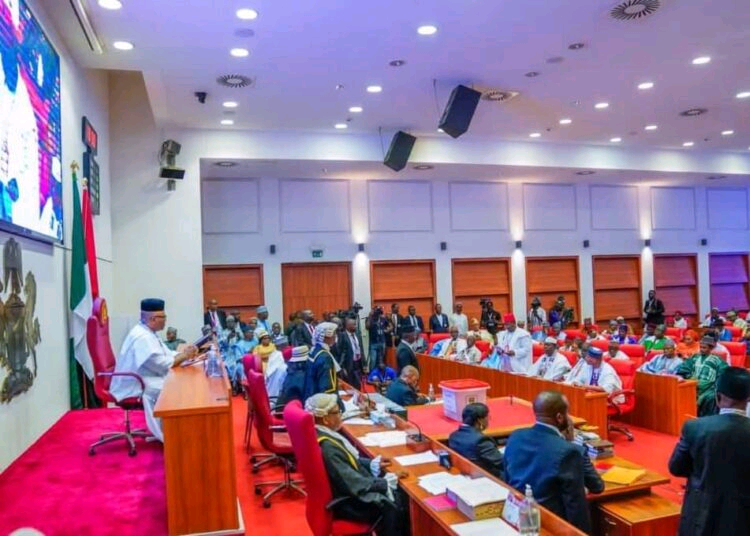
The Senate on Wednesday approved a bill prescribing up to 14 years’ imprisonment for educators convicted of sexually harassing students in tertiary institutions.
The bill, titled Sexual Harassment of Students (Prevention and Prohibition) Bill, 2025 (HB.1597), was presented for concurrence by the Senate Leader, Senator Opeyemi Bamidele, APC, Ekiti Central.
Bamidele explained that the bill is designed to protect students from all forms of sexual misconduct and abuse within academic environments while providing clear legal frameworks for the enforcement and punishment of offenders.
The Ekiti lawmaker further stated that the bill is enacted to “promote and protect ethical standards in tertiary education, the sanctity of the student-educator fiduciary relationship of authority, dependency and respect for human dignity.”
According to the Senate, “Any person who commits any of the offences or acts specified in clause 4 (1), (2) and (3) of this Bill is guilty of an offence of felony and shall, on conviction, be sentenced to an imprisonment term of up to 14 years but not less than 5 years, without an option of a fine.
“(i) Any person who commits any of the offences or acts specified in Clause 4 (4), (5) and (6) of this Bill is guilty of an offence and shall be liable on conviction to an imprisonment term of up to 5 years but not less than 2 years, without an option of a fine.”
The bill also allows students who allege harassment to pursue a civil action for breach of fiduciary duty, stating that the standard of proof shall be the same as in civil proceedings. It outlines a wide range of offences, including demanding sexual favours, making sexual advances, inducing others to commit harassment, and unwanted touching or gestures.
Among other provisions, the legislation clarifies that marriage between the educator and student is the only acceptable defence, and consent shall not be considered a defence where an educator-student relationship exists.
“Sexual harassment complaints may be filed by the student, relatives, guardians or any concerned party to the Police or Attorney-General, with copies also submitted to the institution’s Independent Sexual Harassment Prohibition Committee,” it stated.
During the debate, some lawmakers called for the bill’s scope to be expanded. Senator Adams Oshiomhole, representing Delta North, argued that “there is no need to restrict sexual harassment issues to students. We should craft this law in a way that gives it universal application.”
However, the Deputy Senate President, Senator Barau Jibrin, presiding over the plenary, noted that the bill had already passed through the House of Representatives and was only open for concurrence. He added that existing laws already address harassment in workplace settings.
The bill was subsequently adopted and passed for third reading.
The legislation comes amid a string of reported sexual harassment scandals involving lecturers at universities in Lagos, Port Harcourt, Ilorin, Nsukka, Kano, Benin, and Abuja. Many complainants historically avoided pursuing justice due to fear of victimisation, stigma, or opaque internal disciplinary systems.
Activists and women’s rights groups have long argued that a stronger federal legal framework was needed to break the cycle of silence.