 By Joshua Tosin Ogunsakin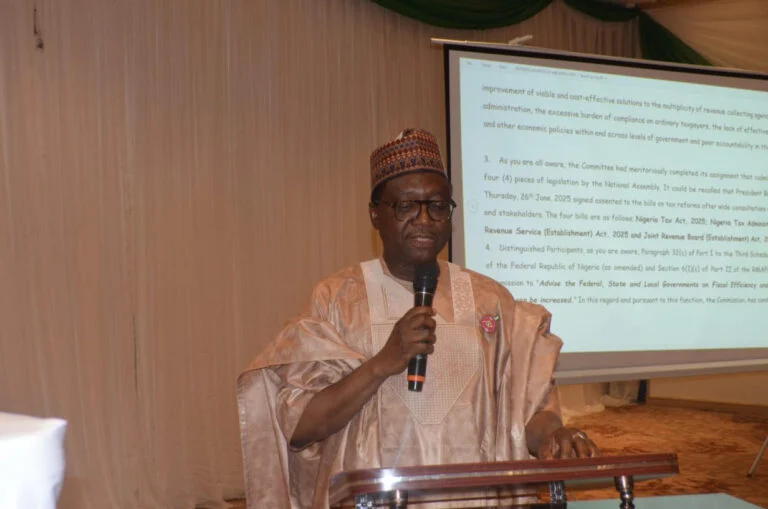
“Remuneration of political office others is completed. We have submitted this through the Secretary to the Government of the Federation to the President.
“We hope that very soon, this will be transmitted to you so that it becomes a law. Of course, your own doesn’t require any legislation. It’s for ministers and others,” he said.
After the presentation of the 2025 budget performance and the 2026 budget defence, Faleke, who presided over the session, commended the management of RMAFC for its role in improving revenue generation for the country.
Interference in local government finances has remained a contentious issue in Nigeria’s federal system for decades.
Although the 1999 Constitution recognises local government administration, allocations to it have often been hijacked by State governors through mechanisms such as the State–Local Government Joint Accounts.
In practice, this has enabled many states to withhold, deduct or redirect local government allocations, undermining service delivery and governance at the grassroots.
Successive administrations, civil society groups and labour unions have blamed the erosion of local government autonomy for poor development outcomes in rural communities, weak primary healthcare and education systems, and the general collapse of local governance structures.
Recent Supreme Court pronouncements and renewed federal pressure on states have brought the issue back to the forefront, with the federal government signalling a tougher stance, including the possibility of executive action, to enforce financial independence for local councils.