
 By Joshua Tosin Ogunsakin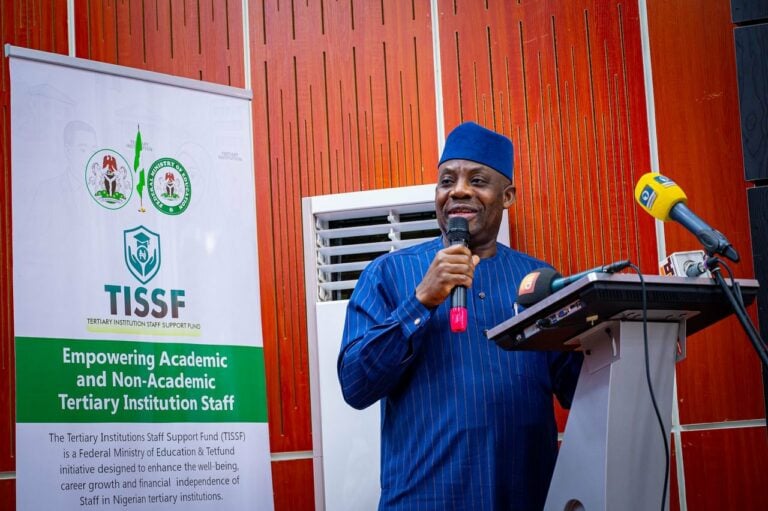
The Federal Government has scrapped the policy that required schools in Nigeria to teach students in their indigenous languages.
According to The Punch, the Minister of Education, Dr. Tunji Alausa, made the announcement on Wednesday at the 2025 Language in Education International Conference, organised by the British Council in Abuja.
The decision was approved at the 69th meeting of the National Council on Education, held from November 3 to 7 in Akure, Ondo State.
The policy, which started in 2022 as the National Language Policy, said children from Early Childhood Education to Primary Six should learn in their mother tongue or the language of their community. Its goal was to promote indigenous languages, give them equal recognition, and help children learn better in the early years. English was still to be used in later education and formal settings.
Speaking at the conference, Alausa said English will now be the language of teaching in all schools, from primary to university.
He explained that the decision was based on evidence showing poor results in areas where students were taught mainly in local languages.
“We have seen a mass failure rate in WAEC, NECO, and JAMB in certain geo-political zones of the country, and those are the ones that adopted the mother tongue in an oversubscribed manner.
“This is about evidence-based governance. English now stands as the medium of instruction from pre-primary, primary, junior secondary, senior secondary, and tertiary education,” he said.
Alausa added, “Using the mother tongue language in Nigeria for the past 15 years has literally destroyed education in certain regions. We have to talk about evidence, not emotions.”
He also noted that students taught mainly in local languages often fail national exams and struggle with basic English.
“The national policy on language has been cancelled. English now stands as the medium of instruction across all levels of education,” Alausa declared.
The minister encouraged anyone with a different view to bring verifiable data, saying the government is open to dialogue based on facts. He also praised the British Council for helping Nigeria improve its education system and language policies.
The Minister of State for Education, Prof. Suwaiba Ahmed, said the government is also working to improve learning for young children.
“Now we are designing a training package for teachers that focuses on literacy and numeracy.
“This specifically targets teachers of pre-primary to Primary One to Three. We are training them on the best methods to teach literacy and numeracy and the appropriate approach to classroom learning,” she said.
The British Council Country Director, Donna McGowan, said the council will continue supporting education in Nigeria.
“We’re committed to working hand-in-hand with the ministry. We work across all areas of education in terms of supporting teacher professional development, school leadership, and language proficiency,” McGowan said.