
 By Joshua Tosin Ogunsakin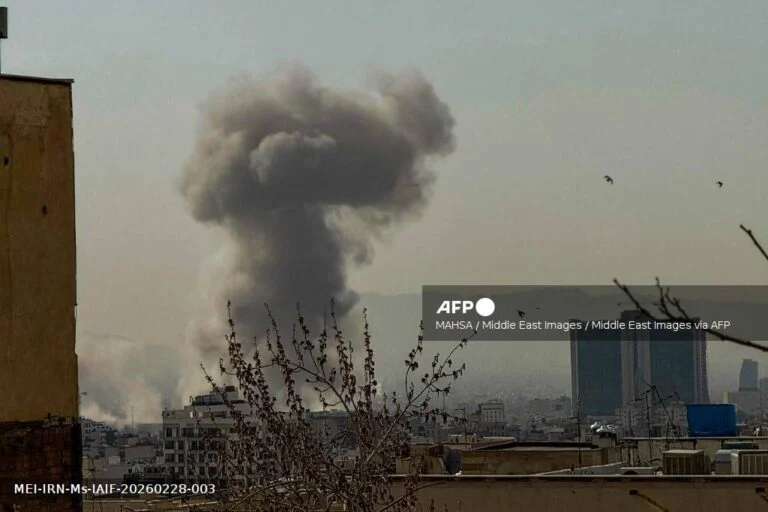
The attacks came after US President Donald Trump expressed frustration at Iran’s stance in negotiations over its nuclear and missile programmes.
Trump said Washington’s goal was “eliminating imminent threats” from Iran, and Israeli Defence Minister Israel Katz described the action as a “preventive strike”.
“The United States’ military began major combat operations in Iran,” Trump said in a video message posted on his social media site while he spent the weekend at his Florida golf club.
“We are going to destroy their missiles and raze their missile industry to the ground. It will be totally, again, obliterated. We’re going to annihilate their navy,” Trump said.
He offered the Iranian military “immunity” or “certain death” and told Iranians the “hour of your freedom is at hand”.
Iranian state television reported that President Pezeshkian was “safe and sound” and the Fars news agency said “seven missile impacts were reported in the Keshvardoost and Pasteur districts” of Tehran.
“I saw with my own eyes two Tomahawk missiles flying horizontally toward targets,” an office worker told AFP on condition of anonymity. “At first we heard a dull noise and thought it was a fighter jet.”
In Tehran, AFP journalists heard blasts and saw two large columns of smoke rising over the city centre. The health ministry said ambulances had been dispatched but there was no immediate confirmation of casualties.
Iran, Iraq and Israel all closed their airspaces to civilian traffic once the strikes were underway, and the US embassies in Qatar and Bahrain urged US citizens to take shelter.
Sirens sounded in Jerusalem and Israeli authorities issued a cellphone warning for citizens.
Trump had ordered the biggest military build-up in decades in the Middle East, with the world’s largest aircraft carrier, the USS Gerald R. Ford, approaching the coast of Israel.
A day after the United States and Iran held talks in Geneva, Trump said on Friday that the cleric-run state was “not willing to give us what we have to have”.
But Oman, which mediated the Geneva talks, offered a much rosier picture and said that Iran had agreed to zero stockpiling of any uranium, rendering moot the question of the level of enrichment.
Iran also agreed to degrade current stockpiles into fuel, said Oman’s foreign minister, Badr Albusaidi, who was in Washington meeting US Vice President JD Vance.
The strikes come weeks after Iranian authorities killed thousands of people as they crushed mass protests.
Iran agreed to restrictions to low-level enrichment in a 2015 deal that Trump ripped up during his first term in office.
Meanwhile, US Secretary of State Marco Rubio will travel to Israel for talks on Iran on Monday, the State Department said.
In a rare break from decades of precedent, the top US diplomat will travel without reporters on his plane.
– ‘Very big problem’ –
Trump in his State of the Union address Tuesday alleged Iran was developing missiles that could strike the United States.
Rubio later said it would be a “very big problem” for Iran if it does not discuss its missiles. Iran has insisted that the ongoing talks focus on the nuclear issue.
Increasing pressure, Rubio on Friday designated Iran a state sponsor of wrongful detentions, a new blacklist, over jailings of US citizens.
Iranian Foreign Minister Abbas Araghchi said Friday that “success in this path requires seriousness and realism from the other side and avoidance of any miscalculation and excessive demands”.
The UN nuclear watchdog, the International Atomic Energy Agency, said it would hold technical discussions with Iran on Monday.
The agency called on Iran to cooperate with it “constructively,” according to a confidential report seen by AFP.
AFP