
 By Hon. Comrade James Onifade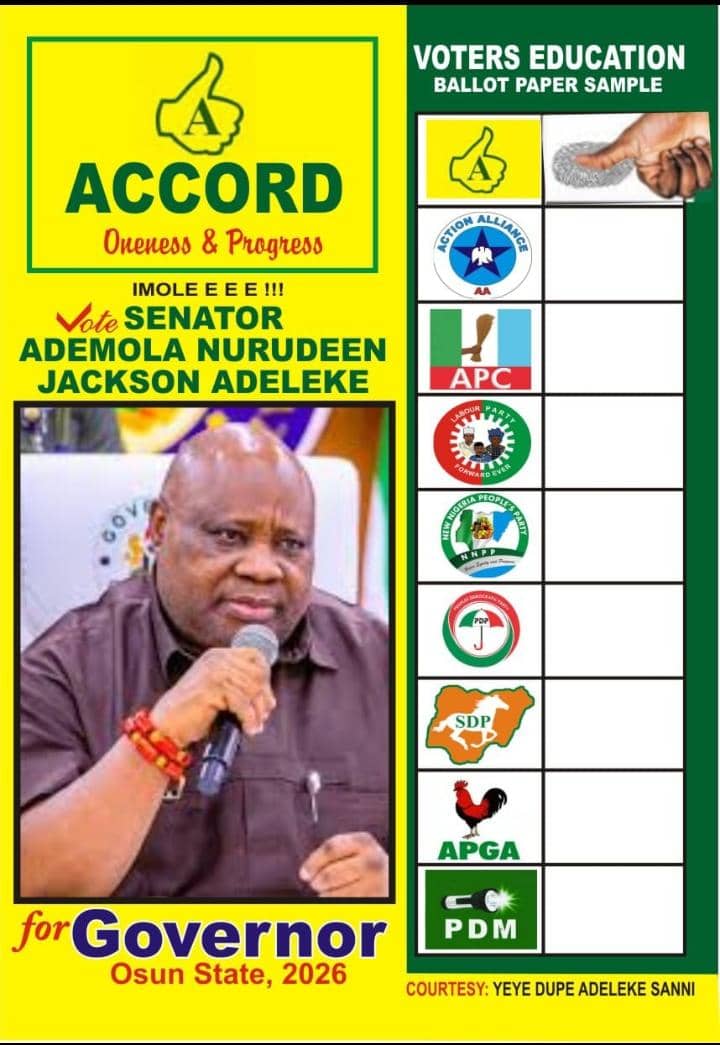
The political landscape of Osun State has witnessed a significant development that deserves careful examination and public discourse. Governor Ademola Adeleke’s decision to pursue re-election in 2026 under the Accord Party platform marks not just a political realignment, but presents an opportunity for deeper democratic engagement and voter education in our state.
The Significance of Political Choice
In a democracy, the freedom of political association is sacred. When a sitting governor chooses a new political vehicle for his re-election bid, it sends ripples through the political ecosystem.
Governor Adeleke’s move to Accord Party is neither unprecedented nor unusual in Nigerian politics, yet it demands that we, as citizens, pay attention and understand what this means for our collective future.
The question is not whether this decision is right or wrong, that is for voters to determine at the polls in 2026. Rather, the crucial issue is whether citizens are adequately informed to make that decision intelligently.
The Critical Need for Public Enlightenment
The absolute necessity of comprehensive public enlightenment. In our democracy, an uninformed vote is as dangerous as a stolen vote. When party platforms change, when political realignments occur, the burden falls on both the political class and civil society to ensure that ordinary citizens are not left confused or disenfranchised.
The sensitization campaign now underway across Osun State is not mere political propaganda, it is a democratic responsibility. Every market woman in Osogbo, every farmer in Ede, every student in Ile-Ife, and every elder in Iwo must understand the basics of how to exercise their franchise effectively come 2026.
Understanding the Ballot Paper: Democracy’s Sacred Document
Let me address something fundamental that often gets overlooked in our political discourse: the ballot paper itself.
The ballot paper is the most important document in any election. It is the physical manifestation of your democratic power. On election day, this single sheet of paper becomes the bridge between your aspirations and your choice of leadership. Yet, many voters approach it with uncertainty, especially when political changes occur.
The parties are arranged in a specific order, typically alphabetical or as determined by the electoral commission.
Understanding this arrangement is crucial because confusion at the polling booth can lead to wasted votes, spoiled ballots, or worse voting for the wrong candidate entirely.
Accord Party: Number 1 on the Ballot
Here is where specific enlightenment becomes critical. Accord Party carries the number 1 position on the ballot paper. In our local parlance, this is represented by the symbol and phrase “Oke Tenten Lawa”—meaning “The Tall Mountain is Ours.”
This is not trivial information. In the heat of election day, when queues are long and tensions high, voters need a clear, simple identifier. The number 1 position at the top of the ballot paper is that identifier for those who wish to vote for Governor Adeleke under Accord Party.
I argue strongly that the ongoing sensitization campaign is not optional, it is a moral imperative. Those who support Governor Adeleke’s re-election bid have a responsibility to ensure that support can be properly expressed at the ballot box. But beyond partisan interests, we all have a civic duty to ensure our fellow citizens can vote confidently and correctly, regardless of who they support.
While I advocate strongly for voter education, I must also sound a note of caution. Sensitization must not become manipulation. Teaching people how to identify a party on the ballot is education; pressuring them on who to vote for is coercion. The line is thin but vital.
Democracy thrives when citizens make informed choices freely. The goal of any enlightenment campaign should be to empower voters with knowledge, not to strip them of agency.
The Bigger Picture: Democratic Maturity
Governor Adeleke’s move to Accord Party and the subsequent need for voter enlightenment reveals something deeper about our democracy. We are still a young democracy, learning to navigate the complexities of political choice, party loyalty, and electoral mechanics.
In mature democracies, voters understand that they vote for individuals and ideas as much as party labels.
In our context, we are still heavily influenced by party colors and symbols. There’s nothing wrong with this, it’s part of our democratic evolution. But it means we must work harder to ensure these symbols are clearly communicated when they change.
As we approach the 2026 gubernatorial election, the quality of our public discourse and the depth of our voter education will shape not just the outcome, but the legitimacy of that outcome. An election where significant numbers of voters are confused or disenfranchised through ignorance is a flawed election, regardless of who wins.
Governor Adeleke’s journey to Accord Party is his political decision. How we, as citizens, respond to it, whether we support him or not will test our democratic maturity. Let us pass that test by ensuring that come 2026, no Osun State resident enters a polling booth confused about what that ballot paper means or how to express their choice clearly.
The ballot paper is not just a piece of paper. It is the voice of the voiceless, the power of the common citizen, the equalizer in our democracy. Let us ensure every hand knows how to use it.
Let there be light again in Osun in 2026
 Joshua Tosin Ogunsakin